Case Study Research Design: Structure, Applications, and Academic Value
Case study research design is a structured research design that is extensively used in scholarly research in order to investigate a complex issue in realistic settings. It provides a systematic approach for researchers to explore complex social, organizational, or behavioural processes, applicable in qualitative, quantitative, and mixed-methods research. The blog also discusses situations where case study design is most appropriate, examines its merits and limitations in the field of education, highlights common mistakes and ways to avoid them, and introduces professional support services, including assistance from experienced case study writers.
At the conclusion, you will understand the reasons as to why this research design is a powerful instrument of scholarly work and how to effectively use it.
What Is a Case Study Research Design?
Case Study Research Design is a formal research design and methods approach used to investigate a phenomenon within its real-world context.This research design and methods framework is a methodical approach to collecting, interpreting, and analyzing data, with an allowance for analytical depth. Its intent in research methodology is to enquire, describe or explain complex processes, relations, and behaviour that are situational. Case study research design allows the researcher to incorporate both qualitative and mixed-method methods toward the achievement of methodical, conceptual, and scholarly validity of findings.
Types of Case Study Research Design
Case study research design can be categorized into three broad categories, i.e. the exploratory, the explanatory and the descriptive research studies. The types all have their academic and methodological purpose. These types allow researchers to select an approach that aligns with their research objectives and ensures analytical robustness in both qualitative and mixed-method studies.
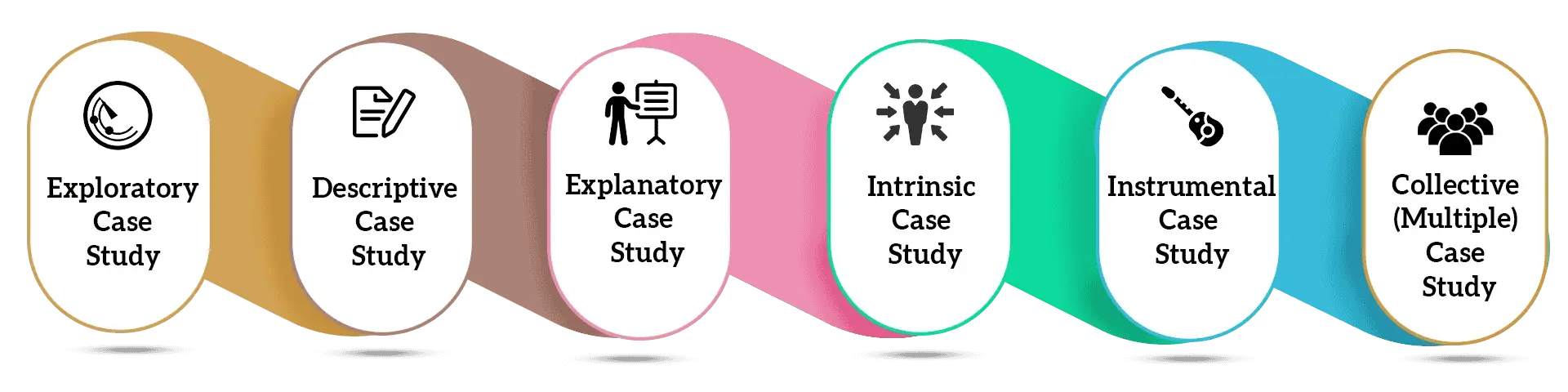
Exploratory Case Study: This is used at the initial stage of the research, and it aids in recognizing the important variables, patterns, or hypotheses. It is aimed at clarifying areas of focus and establishing the preconditions of further research.
Explanatory Case Study: This is the kind of probe that investigates causal relations and gives answers to the reason or way certain results are occurring. It helps the development of theory and also the testing of hypotheses in complicated environments.
Descriptive Case Study: It is a descriptive, systematic description of a phenomenon. It focuses on contextual knowledge, and hence it is crucial in the complete documentation of processes, events or behaviours.
These types allow researchers to align their study objectives with the appropriate methodological approach, ensuring that case study research design remains academically thorough and conceptually relevant.
Key Characteristics of Case Study Research Design
Case study research design is defined by several features that make it distinct and valuable in academic research:
Depth of Analysis
-
Gives an in-depth examination of a subject from different perspectives.
-
Records the interactions and relationships that are subtle and complicated by using simple approaches.
-
Crafts evidence-based, analytical, and solid findings.
Context‑Specific Investigation
-
The focus is on understanding developments within their natural environments
-
Combines the environmental, organizational, cultural, and social aspects to interpret them profoundly.
-
Provides information that can be implemented in a real-life scenario.
Concentrating on Real-Life Processes
-
Works are based on real events, behaviors or processes rather than abstract situations.
-
Generates authentic, reliable data that strengthens the literature review in research.
-
Bases its discoveries on concrete reality, making them scholarly.
Advantages of a Case Study Research Design
The advantages of a case study research design lie in its ability to generate meaningful, academically precise insights while directly addressing research objectives.
Comprehensive Understanding: The design provides in depth lessons to both the theoretical and real learning through observing a phenomenon in a real life scenario. Such richness reinforces the contributions in literature and informs the research in the future.
Flexibility in Research Methods: A case study design provides various approaches to improve the fidelity of the methods, including interviews, observations, and archival research, which guarantees data triangulation.
Alignment with Research Objectives: The advantages of a case study research design include its ability to directly address specific research questions. Its targeted approach increases the relevance, validity, and applicability of findings in academic discourse.
Rich Qualitative Data: It allows scholars to model the intricate human interactions and behaviours, generating data that can be used in both theory and practice. The critical nature of the studies also makes the research scholarly but not just descriptive.
Limitations of Case Study Research Design
Although case study research design presents a number of benefits, the research design has objective limitations, which should be taken into consideration by researchers.
Limited Generalizability: The results of one case or a small number of cases relate frequently to the context, and it is difficult to extrapolate the results to other contexts or groups.
Time-Intensive Process: To undergo a thorough case study, it must take much time to collect and analyze data, create a very intense report, something that may not be feasible when the case study is done on a large scale basis.
Potential for Subjectivity: The researcher might have a subjective approach to data interpretation, particularly in qualitative analysis, which results in the possibility of biasing the results and making them subjective.
Complex Data Management: Handling more than a single source of data, i.e. interviews, documents and observations, can issue organizational, synthesis, and analytical problems.
Replication Challenges: Since each case is unique in its circumstances, it is often hard to replicate the study in a different setting, and thus, the study becomes less replicable.
These are a few of the limitations that suggest careful planning, methodological exactness and transparency in the use of case study research design to make findings credible, but recognize limitations in this type of research.
Case Study Research Design in Academic Research
Case study design is frequently employed by researchers in scholarly work, particularly in research dissertations, journal articles, and thesis. Their methodology chapter provides reasons as to why they selected this design, the type of cases they used, and data collection and analysis methodologies.
By clearly detailing the case study approach, researchers provide transparency and methodological rigor, demonstrating how the study addresses specific research questions. It is also possible with the design to explore complex processes and mechanisms systematically and highly organize academic work in the context and research aims, as well.
Common Mistakes While Using Case Study Research Design
Several common methodological mistakes can undermine the effectiveness of a case study research design:
-
Unclear focus of the research is a consequence of a poor match between research questions and case selection.
-
Trust in the evidence depends on relying exclusively on one source of data.
-
Failure to consider the contextual factors usually results in a lack of complete analysis.
-
Having a poorly described methodology in academic writing renders the writing less clear and difficult to replicate.
Early recognition of these errors will enable researchers to maintain integrity in designing the research and generate viable academic work.
Expert Support for Case Study Research Design and Writing
The case study design may be challenging. The researchers need to design the research, select a type of case, and correlate the study with its goals. To achieve this successfully, one has to have a good understanding of research methodology and proper planning in order to maintain academic discipline.
These challenges can be overcome by the use of our case study writing services. They ensure proper design, present justification of methods used and format the dissertation, thesis or journal article properly. Ethical support is also a priority of these services, and they provide original and plagiarism-free work of high academic standards.
The case study writing services contribute towards the generation of credible, methodologically sound, and well-organised research by providing systematic guidance to researchers.
Conclusion
A case study research design is a useful method in academic research because it provides a clear framework for studying complex processes in the study. The fact that it is most useful when it comes to qualitative and mixed-method research is owed to its methodological meticulousness, flexibility, and focus on real-life insights.
By understanding its types, characteristics, applications, advantages, limitations, and potential pitfalls, researchers can leverage this design effectively, producing academically credible and methodologically sound work.




 By Emilia